
Bringing Research to Life: Inside UM-Dearborn’s Inclusive Storytelling Hub

Reena Hamad Editor-in-Chief

Some of the most important work that happens in the university setting is also the hardest to share beyond academic circles. At the University of Michigan-Dearborn, a new initiative is working to close that gap by turning scholarship into stories the broader campus community can see, hear, and feel.
Founded in 2024, the Inclusive Storytelling Hub (ISH) works with students, faculty, staff, and researchers across the UM-Dearborn campus to translate campus scholarship into dynamic digital stories. Supported by the Inclusive History Project (IHP) and the Office of Holistic Excellence (OHE), ISH is more than a production unit; it is a collaborative bridge between faculty expertise, student talents, and public-facing storytelling.
The ISH production lead Rick Morrone brings more than 15 years of experience across advertising, music and video production, editing, and everything in between to his work overseeing media projects and supporting students.
Jen Proctor, an associate professor of Journalism and Media Production (JuMP), serves as ISH’s executive producer. Proctor had long envisioned a campus center dedicated to digital storytelling, and the opportunity to formally launch ISH came when funding support through IHP made it possible. She saw significant demand from the campus community doing meaningful research without a consistent and innovative way to turn them into something comprehensible for larger audiences. ISH evidently became exactly that resource based on its latest projects.
The Inclusive Storytelling Hub is currently completing one of its first major undertakings: a documentary centering Dr. Blenda J. Wilson, the first and only Black woman to lead a campus of the University of Michigan. She served as chancellor of UM-Dearborn from 1988 to 1992 and Dr. Camron Amin, IHP director of research on the Dearborn campus, and Marlaine Magewick, digital humanities coordinator, encountered a portrait of her in the campus archive in 2024. It turned out, Dr. Wilson had never gotten to see it. This finding not only gave the project archival material, but a living subject who could respond to a piece of her own institutional legacy–on camera.
The documentary, Best in Class: Blenda J. Wilson, Jon Onye Lockard, and the Portrait that Connected Them, weaves together archival materials including oral histories of Dr. Wilson from 2000 conducted by Elton Higgs and an updated version done in 2025 by the IHP and ISH team, as well as interviews with colleagues of Dr. Wilson and Jon Onye Lockard who is the artist behind the portrait that sparked the project to life.
ISH also serves as a training ground for student interns. JuMP student Marcos Carrillo joined the team as an intern at the beginning of Fall 2025. In addition to playing a major role in production and editing on the Blenda Wilson documentary, Carrillo has also contributed to a unique campus effort focused on “restoring native voices and bringing indigenous values to the campus,” he says. The initiative features a garden near the Natural Sciences Building originally planted by an Indigenous beekeeper. Having started his academic path in biology at Henry Ford before committing to media production at UM-Dearborn, Carrillo values the internship environment in that much of the learning happens inside real production workflows.
Intern Benjamin Filler, an award-winning filmmaker and JuMP student, was described by his colleagues as an exceptional peer mentor. He described having “lived a life before going back to school,” and having a chance to also draw on his experience as a tutor in digital video production and an adjunct instructor at Oakland Community College, where he earned his Associate in Cinematic Arts in 2024. As he puts it: “I love seeing other people have ‘aha!’ moments,” something clearly reflected in his contributions to the studio.
While ISH builds interns’ technical skills with camera, audio recording, and editing, Proctor emphasizes that to her, the most important learning she works to foster is centered around teamwork to find a story inside what’s often a mountain of archival material and choosing the right pieces responsibly and creatively. She notes that when a project includes real people, marginalized communities, and stories involving institutional power, “every edit has an ethical question behind it.”
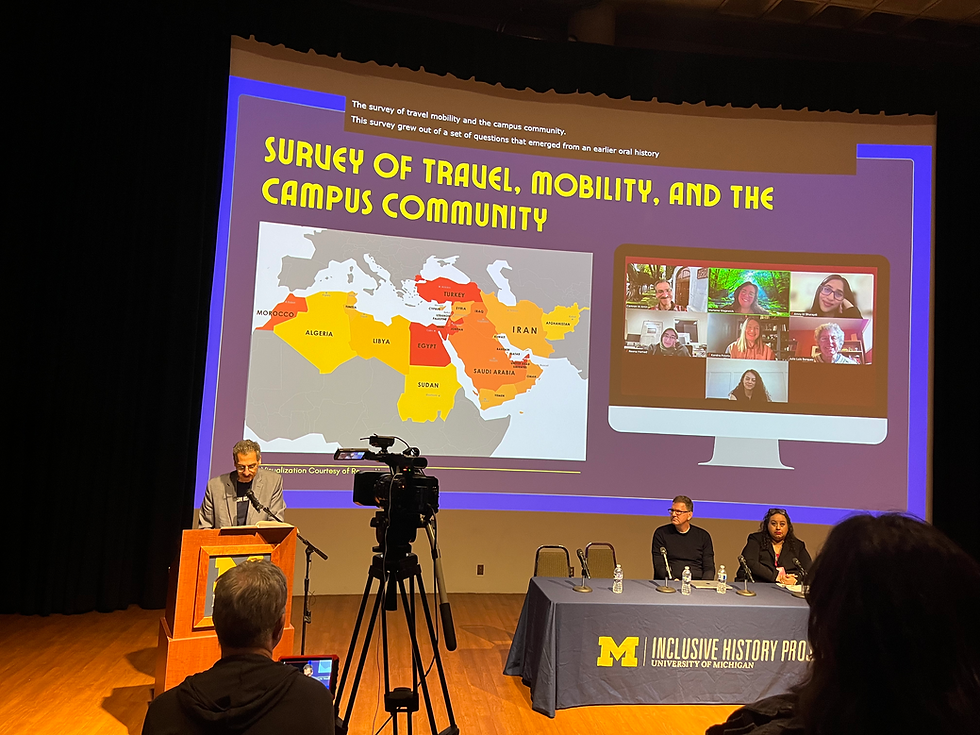
In other public-facing work, ISH has contributed to a promotional video encouraging people to share stories to Dr. Amin’s Michigan Middle East Travelers Oral History Project (MMETOHP). The collection is an effort that focuses on lived experiences of travel and connection over state policy, aiming to capture a broader mosaic of movement, identity, and perspective in the region. To Dr. Amin, collaboration with ISH offers creative uses of the JuMP studio and extends the goal of using the University as “an evolving case study” that reveals insights about the institution as well as societal and historical trends from the local to the international level.
ISH proves that storytelling can extend the reach of research without flattening its meaning, and in fact, enhances it. For UM-Dearborn, the Inclusive Storytelling Hub is a way of bringing campus knowledge into the campus community where it can be seen, reflected on, and used to cultivate a more inclusive campus.


Comments