
IHP Summit 2026 explores histories of inclusion and exclusion

By Reena Hamad
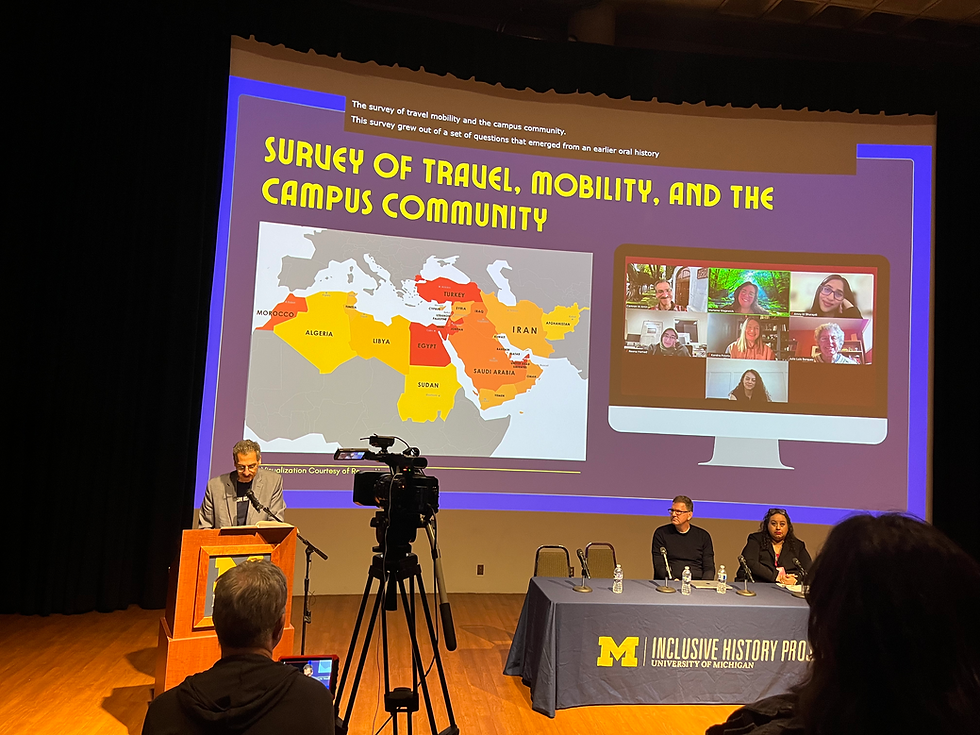
The 2026 Inclusive History Project Summit held at University of Michigan-Flint brought together students, faculty, staff, alumni and community members for a day centered on two difficult but necessary questions: How can and should the University of Michigan confront its institution’s histories of inclusion and exclusion across its three campuses, and how do we ensure repair goes beyond simple acknowledgment?
IHP Research Directors Camron Amin, Jay Cook and Lisa Lapeyrouse started the event by exploring some of their campus project sites, showcasing some of the real-time progress made toward IHP’s vision of research, engagement and repair.
One of the opening sessions, “Geographies of Justice and the Changing City,” was a roundtable discussion focused on the history and impact of urban renewal in Flint. Speakers spoke of displacement, the changing landscape of the city and the University of Michigan-Flint’s place within those shifts.
The conversation also turned to the role of archives in preserving these histories, as well as the collaborative work behind the “Blueprints of Power” exhibition, conveying how public history depends not only on what happened but also on what was documented, preserved and interpreted.
The summit also hosted interactive programming. As part of the “Make, Meet, Learn” session, Flint artist and educator My Proulx led “From Protest to Pride,” a button-making workshop that connected personal expression to the longer history of buttons as tools of activism, organizing and identity. Participants used a range of materials to create wearable designs rooted in inclusive history, place and self-expression.
Just a few steps away, attendees were invited to make themselves part of the institution’s record with the help of the IHP Student Advisory Committee. The “Belonging Interactive Photo Mural” asked participants to take a photo and add it to a growing collective display as a statement that the history of the university is actively unfolding. The initiative welcomed participants to have a visible place within it.
That notion of historical recovery and ongoing curation ran through the summit’s sessions of lightning talks. Christina Blitchok, U-M Flint campaign initiatives and alumni engagement director, presented on the 1956 Project, which documented the first students and faculty at U-M Flint, using individual stories to reconstruct what the campus looked like at its beginning and measure what has changed since.
Rose Wellman, associate professor of anthropology at U-M Dearborn, and Amny Shuraydi, assistant professor of criminology and criminal justice at U-M Dearborn, discussed their project studying U-M Dearborn’s Center for Arab American Studies and student life. Their presentation explored identity and inclusion on a campus deeply shaped by Arab American communities.
Several projects also focused on the institutions that collect and preserve historical materials. Jodi Mase, U-M Ann Arbor graduate research associate, and David Mori, U-M Ann Arbor doctoral student, discussed a collaboration between the Bentley Historical Library and the School of Information. Their project challenges the assumption that universities should simply gather records from marginalized communities for scholarly use and instead calls for a relationship-building model of historical care.
Wallace Bowie III, Karen Burton, Saundra Little and Craig Wilkins similarly emphasized the labor of historical recovery in their lighting talk that traced the histories of Donal White and Francis Griffin, who are recognized as Michigan’s first Black architects. Bowie, a research assistant for IHP, emphasized their focus on presenting “what it actually looks like to recover a history that has been scattered across archives, institutions and communities.”
Ivy Forsythe-Brown, U-M Dearborn associate professor of sociology, and Terri Laws, U-M Dearborn associate professor of African and African American studies, echoed a similar effort in presenting their developing project of uncovering the history of African and African American studies on the Dearborn campus with the help of oral history.
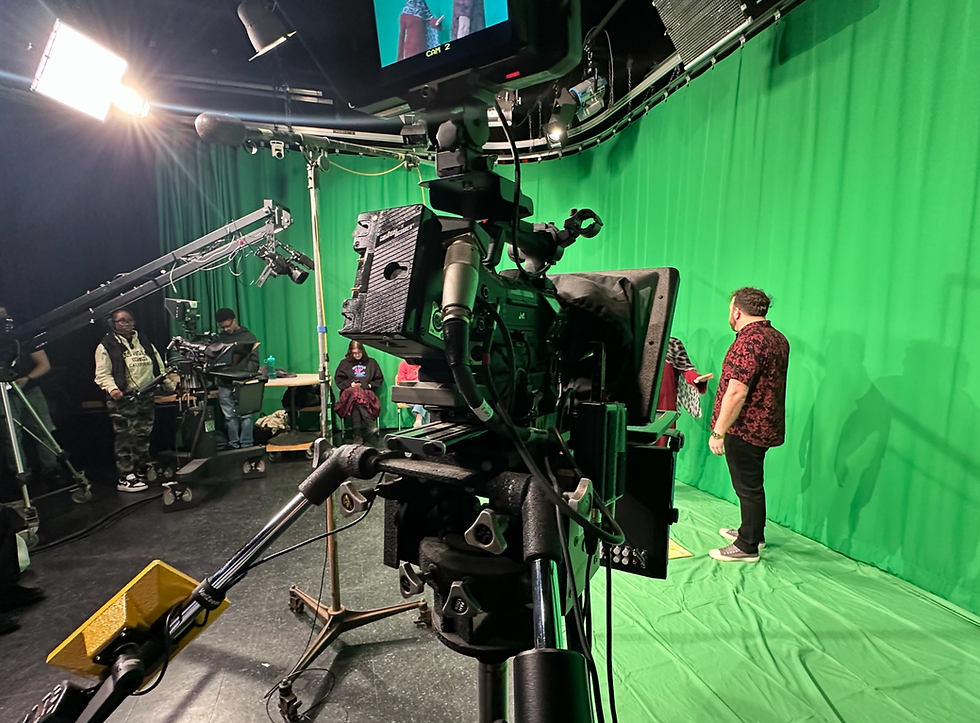
The Inclusive Storytelling Hub also made an appearance at the IHP Summit. The Wolverine Stories Video Booth invited summit participants to share personal stories about their experiences at the University of Michigan, including memorable moments, challenges and accomplishments.
Inspired by the StoryCorps oral history model, the booth was created by U-M Dearborn’s ISH to collect stories of inclusion and exclusion from anyone connected to the University of Michigan. These short recorded stories may help support future oral histories, documentaries and other projects about the University’s institutional history.
This summit marked the midpoint of the Inclusive History Project’s current five-year phase. IHP aims for these initiatives to reflect a shared method emerging across campuses and disciplines that treats history as a collaborative, community-facing work rather than an idle institutional narrative. Attendees saw the use of oral history, archival recovery, public art, course design and community-based planning to, in the words of IHP co-chair Elizabeth R. Cole, “enrich and deepen our understanding of the University’s full history.” All presenters noted that doing so requires more than simply adding overlooked names and communities to the record, but also rethinking who shaped that record in the first place.


Comments